There was a time when building a strong company page on LinkedIn felt like the center of a B2B content strategy. You polished the messaging, scheduled your posts, pushed traffic to gated assets, and could rely on consistency translating into growth.
That era is quietly ending.
In 2026, the growth engine for B2B brands is not the company page. It is the people inside the company. It’s employee-generated content from your subject matter experts. It’s LinkedIn Personal Accounts and the activity by those employees. More specifically, it is their visibility, thought leadership, and consistent presence on LinkedIn and on long-form channels like podcasts.
This is not a stylistic shift. It is both behavioral and algorithmic. And the data backs it up.
Personal LinkedIn Profiles Are Outperforming Company Pages
Refine Labs recently analyzed LinkedIn personal accounts performance data by normalizing engagement and impressions against follower counts. What they found was hard to ignore. On a per-1,000-follower basis, employee posts significantly outperform company page posts in both impressions and engagement, and that trend holds consistently over time. Often by as much as a factor of five.
When you step back, it makes sense. LinkedIn is engineered for person-to-person interaction. The algorithm favors conversation, dwell time, and engagement between individuals. A corporate logo does not generate the same signals as a real person sharing a lesson, an opinion, or a story from experience. Quite the opposite.
Even LinkedIn’s own guidance increasingly encourages executive visibility and personal branding as part of organic growth strategies. This matters because engagement is not just about reach. Engagement is a proxy for trust. And trust is what shortens sales cycles.
If you are a B2B company wondering why your polished brand posts struggle while an executive’s casual insight gains traction, it is not random. The platform is rewarding human context over corporate polish.
Thought Leadership Is Not More Content. It’s Clear Perspective.
We talk about thought leadership constantly in B2B, but most companies still treat it like a frequency problem. Post more. Publish more. Repurpose more.
That is not what is working.
Thought leadership in 2026 is about original perspective rooted in real operating experience. It is a founder articulating where the market is heading. A CMO explaining what is actually driving pipeline versus what looks good in a report. A product leader sharing the patterns they are seeing across customers.
When buyers consistently consume this kind of insight, something subtle happens. They feel a sense of familiarity before the first sales call. They feel alignment before reviewing a proposal. They start to associate your brand with clarity instead of noise.
This aligns with broader trust data across digital marketing. The Edelman Trust Barometer continues to show that people trust “people like me” and industry experts significantly more than institutional messaging alone.
The implication for B2B content strategy is simple but uncomfortable. Static brand content rarely builds trust at scale. Human perspective does.
Podcasts Are Becoming Trust Infrastructure
This is where podcasting enters the conversation more strategically.
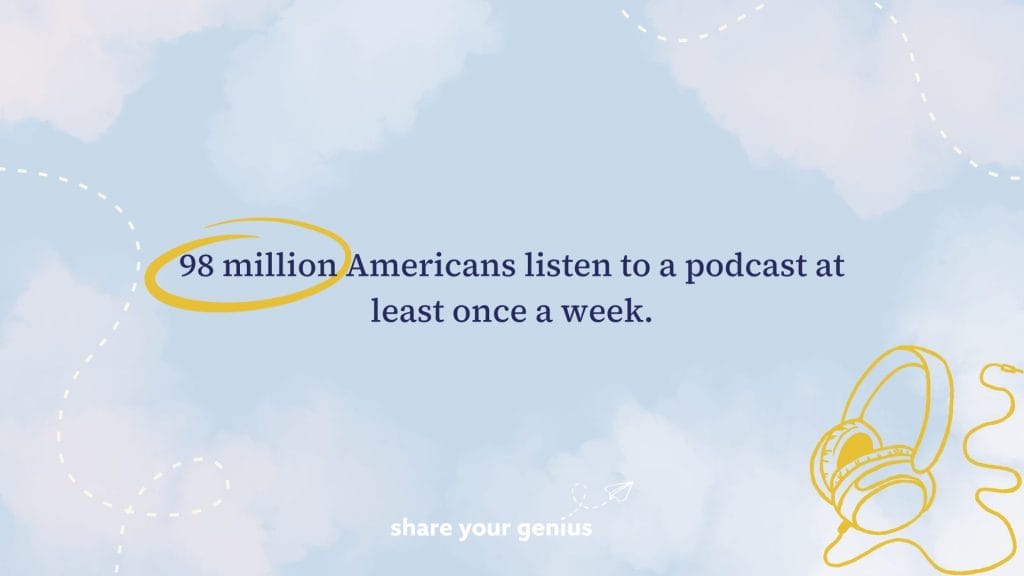
According to Edison Research’s Infinite Dial report, podcast listenership continues to grow year over year in the United States, with 47 percent of Americans over age 12 listening monthly and 98 million listening weekly.
At the same time, YouTube has become the most-used platform for podcast consumption, capturing roughly 31 percent of weekly podcast listeners, followed by Spotify and Apple Podcasts. That shift reflects a broader trend toward video-enhanced and multi-platform podcast distribution.
What matters for B2B leaders is not just the size of the audience. It is the depth of attention. When someone listens to your podcast for 30 or 45 minutes, they are not skimming. They are investing time with you.
That is fundamentally different from a scroll-by social impression.
When structured intentionally, a podcast becomes more than a show. It becomes a strategic content hub. Each conversation can fuel posts on LinkedIn personal accounts, short-form video clips, SEO-optimized blog content, newsletter insights, and sales enablement materials. Instead of creating disconnected assets, you create a central engine of perspective.
This is also why Google and AI search systems increasingly surface in-depth, experience-driven content. Long-form insight signals authority. Conversations demonstrate subject matter depth. Human specificity performs better than generic summaries.
In other words, podcasting is not an audio tactic. It is a trust multiplier.
Turning People Into Platforms
If you combine the LinkedIn data with the growth of podcast consumption and the increasing importance of trust signals, the strategic direction becomes clear.
B2B growth in 2026 favors companies that turn internal leaders into visible platforms.
That does not mean every employee needs to become a content creator. It means identifying two to five individuals whose perspectives can shape market perception. Founders, CMOs, product leaders, customer-facing operators. People who have real pattern recognition.
From there, the goal is not random posting. It is building a repeatable rhythm.
A weekly LinkedIn cadence grounded in clear points of view. A monthly podcast that explores real customer problems. Short-form video derived from those conversations. Long-form articles that capture searchable insights like “internal influencer strategy,” “executive content strategy,” or “media-led growth for B2B.”
When executed consistently, this approach compounds. Prospects start referencing posts in sales calls. Target accounts engage before outreach begins. Search traffic grows around owned themes. Inbound inquiries reference specific episodes or perspectives.
These are not vanity metrics. They are signals of influence.
Why the EEAT Framework Performs in AI and Search
There is also a structural SEO advantage to this strategy.
Search engines and AI systems increasingly prioritize original, experience-based content. Google’s helpful content updates and emphasis on E-E-A-T (Experience, Expertise, Authoritativeness, Trustworthiness) reward insight that demonstrates lived knowledge rather than generic aggregation.
When your executives consistently publish perspective-driven content, you naturally expand your keyword footprint. You build topical authority in specific B2B niches. You generate backlinks and dwell time from deeper content. And you create structured information that AI systems can reference when summarizing industry trends.
In short, human-first content is not at odds with search optimization. It strengthens it.
What’s changed in B2B Social Engagement
The companies winning in B2B right now are not necessarily louder. They are more visible through their people. They are clearer about what they believe. They are disciplined about turning conversations into content systems.
People follow people. Buyers trust experts. And algorithms amplify interaction.
Brand pages still matter. But they are no longer the growth engine. They are the support system.
If your executives remain silent while your competitors build audience equity every week, the gap will widen over time. The question is not whether thought leadership works. The question is whether you are willing to operationalize it.
In 2026, the brands that grow will think less like advertisers and more like media companies. They will activate internal voices. They will publish consistently. And they will treat trust as the primary asset their content is designed to build.
That is the new growth engine.