Thought leadership has become one of the most overused phrases in B2B marketing.
Every company says they are doing it. Most are just publishing content.
In 2026, as AI floods the internet with competent but forgettable material, thought leadership is no longer about producing more content. It is about producing perspective.
And perspective does not come from logos. It comes from people.
At Share Your Genius, we define thought leadership differently than most agencies. It is not a campaign. It is not a quarterly report. It is not a polished CEO article that reads as if it passed through seven layers of brand approval.
Thought leadership is repeatable, experience-based insight distributed through humans, not brand pages.
Let’s break that down.
What Is Thought Leadership Content?
A Modern Definition of Thought Leadership
Thought leadership content is insight rooted in real-world experience, delivered consistently through a recognizable voice, focused on helping buyers think differently, and designed to build trust over time.
It is not generic industry commentary. It is not repackaged blog posts. It is not brand messaging disguised as opinion.
Modern B2B buyers do not need more information. They need clarity.
Thought leadership provides that clarity by answering questions like:
- What is actually happening in this market?
- What are people getting wrong?
- What have we learned from doing this work repeatedly?
The difference is subtle but powerful. Real thought leadership teaches from lived experience, not theory.
Thought Leadership vs. Brand Content
Brand content explains what you do. It highlights your product, your differentiation, and your services.
Thought leadership reframes how your audience thinks. It shares what you are seeing. It explains what most companies misunderstand. It draws from real lessons learned in the field.
Brand content promotes. Thought leadership interprets.
Brand content centers the company. Thought leadership centers on the buyer’s problem.
The strongest B2B companies understand that trust is built through perspective before it is built through product.
Check out our LinkedIn Live about content and trust with Aneesh Lal, Founder of the Wishly Group
Why Buyers Trust People More Than Companies
There is a reason executive-led and operator-led content consistently outperforms company pages.
LinkedIn data shows that employees’ combined networks are about 12 times larger than a company’s own following. When employees share perspectives as practitioners first and brand representatives second, credibility rises.
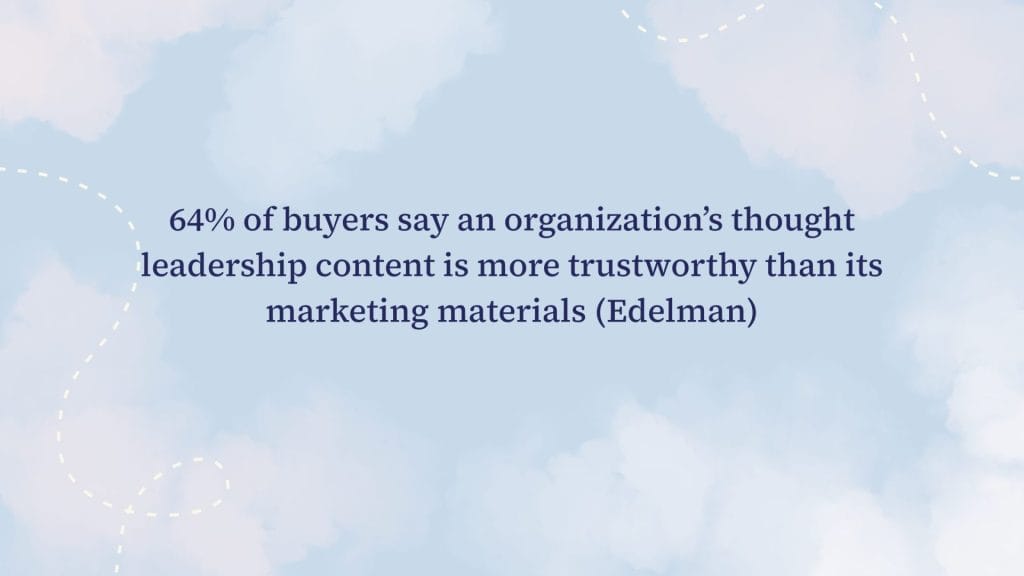
At the same time, 94 percent of B2B marketers agree that trust is the most important factor in succeeding as a B2B brand.
Trust does not scale through logos. It scales through recognizable people who show their thinking, share their experiences, take clear positions, and speak with specificity.
In an AI-saturated market, generic content blends in. Human perspective stands out.
Why Most B2B Thought Leadership Fails
Most companies are not failing because they lack intelligence. They are failing because they lack structure and discipline around perspective.
It’s Too Generic to Be Memorable
AI has made it easy to produce competent content.
According to HubSpot’s 2026 State of Marketing report, 52 percent of marketers believe AI makes content so easy to create that it is less effective overall, and 53 percent struggle to differentiate in an AI-saturated market.
Generic content does not offend anyone. It also does not move anyone.
If your thought leadership could be posted by five of your competitors with no changes, it is not thought leadership. It is filler.
It Sounds Like Marketing, Not Experience
Buyers can detect marketing language immediately.
Thought leadership fails when it over-indexes on product mentions, avoids strong opinions, hides behind safe corporate phrasing, or reads like it has been sanitized beyond recognition.
Real perspective is often slightly uncomfortable. It challenges assumptions. It speaks from scars, not slides.
The most credible content in B2B today sounds like operators talking, not marketers polishing.
There’s No Consistent Point of View
Many B2B companies occasionally publish thought leadership. Very few build a consistent narrative.
In the same HubSpot study, 61 percent of marketers agree that expressing taste and brand point of view is essential in the AI era. Yet 40 percent of teams have not clearly defined their unique value proposition.
Without a repeated point of view, posts feel disconnected, messaging shifts weekly, and audiences cannot articulate what you stand for.
Thought leadership is not one good post. It is a lens you repeatedly use to interpret your market.
The Types of Thought Leadership That Actually Perform
Not all thought leadership performs equally. The highest-performing formats share one trait. They are rooted in real work.
Operator-Led Insight
This is content from people actively doing the work.
- A Head of Customer Success explaining common implementation failures.
- A sales leader breaking down why deals stall.
- A product manager outlining roadmap tradeoffs.
Operator-led insight works because it is specific. Buyers trust operators because they speak from experience, not abstraction.
Executive Perspective and Market POV
Founders, CEOs, and CMOs bring narrative gravity. Their role in thought leadership is to define what is changing, predict where the market is headed, and articulate their beliefs about the category.
This is where category positioning lives. It is not about posting every day. It is about consistently reinforcing a clear perspective over time.
The strongest executive-led thought leadership does not just explain trends. It names them.
Educational Content Rooted in Real Work
Educational content still matters, but only when it is grounded in real examples. For example:
- How to structure a RevOps team at Series B.
- What to fix before hiring your first VP of Sales.
- How to evaluate podcast ROI in B2B SaaS.
Education performs when it includes tradeoffs, nuance, and hard-earned lessons. The goal is not to appear smart. The goal is to make your audience smarter.
Distribution Is the Real Differentiator
Even strong thought leadership fails without intentional distribution.
Publishing is not the same as being seen.
Why Publishing Alone Is Not Enough
The internet is crowded, and attention is fragmented.
Short-form video is now the highest-ROI content format for marketers, with significantly more teams investing in it year over year. At the same time, 75 percent of marketers use five or more marketing channels.
If your thought leadership exists only as a blog post or a quarterly PDF, it will not compound.
Modern distribution requires repurposing across LinkedIn, short-form video, YouTube, newsletters, podcasts, and SEO-driven blog content.
Where Thought Leadership Actually Performs Today
Thought leadership performs best in environments where conversation is native, and individuals can build recognizable followings.
- LinkedIn for practitioner-led perspective.
- YouTube for searchable expertise.
- Podcasts for depth and trust.
- Short-form video for reach and familiarity.
It is not about chasing every platform. It is about choosing where your buyers already pay attention and showing up there consistently.
The Role of Video, Social, and Long-Form Together
Each format plays a different role in the ecosystem.
- Short-form video builds familiarity and reach.
- LinkedIn posts create conversation and authority.
- Long-form blog content builds search equity and depth.
- Podcasting builds trust and long-term connection.
Thought leadership compounds when one idea becomes many formats. A single recorded conversation can become multiple clips, posts, articles, and newsletter features. The insight remains consistent. The format adapts.
How to Build Thought Leadership Without Burning Out Your Team
The most common hesitation executives have is time.
They do not want to become full-time creators. They should not have to.
Turning Conversations Into Content
Most strong thought leadership already exists inside your organization. It lives in sales calls, customer conversations, internal strategy meetings, and podcast recordings.
Instead of asking executives to write from scratch, capture structured conversations. Use interviews to extract patterns, observations, opinions, and lessons.
From there, shape and distribute the insight.
Building Systems Instead of One-Off Posts
Random posting creates exhaustion. Systems create sustainability.
A strong thought leadership system includes defined content pillars, clear point-of-view themes, recurring formats, batch recording sessions, and repurposing workflows.
Instead of asking what to post today, you operate from a content architecture that guides what gets created and why.
This is where most B2B companies fall short. Not on intelligence, but on operationalization.
What Most Teams Get Wrong About Consistency
Consistency does not mean daily posting. It means narrative repetition.
Your audience should be able to predict the types of problems you talk about and the angle you take.
Consistency builds recognition. Recognition builds trust. Trust builds pipeline.
Ready to Build a Real Thought Leadership Engine?
If your company has experienced operators and executives but no system for turning their insight into consistent, high-performing content, we can help.
At Share Your Genius, we build thought leadership systems that activate your internal experts without turning them into full-time creators.
Book a strategy session with us to identify whose perspective should lead, what narrative you should own, and how to turn conversations into compounding content.
Book a meeting with Share Your Genius, and let’s build your thought leadership engine.