Picture this: a marketing leader walks into a leadership meeting, slides a quarterly report across the table, and before they can say a word, the CMO asks the question that has haunted branded podcast programs for a decade.
“How many downloads are we getting?”
It’s a reasonable question. It’s also almost always the wrong one.
Downloads became the default metric for podcast reporting because they were easy to pull, easy to report, and appeared precise. Early podcast platforms made download counts front and center, media companies built ad rate cards around them, and the metric stuck. When B2B brands started launching their own shows, they inherited the same vocabulary without questioning whether it applied.
It mostly doesn’t.
Downloads track file delivery. They do not track pipeline influence, relationship quality, brand authority, deal acceleration, or any of the outcomes that actually justify a podcast investment inside a B2B organization. The companies getting the most from their podcasts have quietly moved past download obsession. They’re measuring something harder to count, but far more meaningful to report.
This guide lays out that framework.
Why Download Counts Became the Default Metric (and Why They’re the Wrong One)
The download benchmark originated in consumer podcasting, where the economics made it the right proxy. If you’re selling advertising inventory, downloads predict revenue. Advertisers pay per thousand listeners, so audience volume is the business model. The metric makes sense in that context.
B2B podcasts operate on entirely different economics.
A B2B show is not a media business trying to monetize an audience. It’s a content asset trying to influence buyers, build category authority, and create relationship infrastructure for a sales and marketing team. The question isn’t how many people downloaded an episode. The question is whether the right people engaged with it, and what happened next.
This distinction matters more than most marketing leaders realize. A podcast with 500 highly engaged listeners- CFOs, VPs of operations, heads of revenue at companies in your ICP- can generate more pipeline impact than a show with 50,000 casual listeners who have no budget or buying authority. Audience size and audience quality are not the same measurement.
According to benchmark data we track across our client roster at Share Your Genius, B2B shows average 321 downloads per episode in the first seven days and 460 average monthly downloads. That puts most B2B shows in the top 25% of all podcasts globally. But the number we watch most closely is a 67% average retention rate because that tells you people are actually listening, not just clicking.
Retention signals resonance. Downloads just signal reach.
The Three Types of B2B Podcast ROI
Most companies measure podcast performance through one lens: pipeline. They ask whether the show is directly generating leads or revenue, and when the answer isn’t obvious, they question the investment.
That’s not the wrong question. It’s just an incomplete one.
There are three categories of ROI that a well-run B2B podcast generates, and most programs track only one.
Pipeline ROI covers the direct commercial outcomes: influenced opportunities, sales call mentions, and deal acceleration.
Relationship ROI covers the access, trust, and executive relationships created through the show, particularly through guests.
Brand ROI covers authority, positioning, and market perception over time.
The companies that get the best returns from podcasting are measuring all three, even when some of it is harder to quantify.
Pipeline ROI: Connecting Your Show to Revenue Conversations
Pipeline ROI is the most straightforward category to define and the hardest to attribute cleanly. That’s not a reason to stop trying.
The goal here isn’t perfect attribution. The goal is directional signal. Marketing leaders need to be able to say, with reasonable confidence, that the podcast is contributing to revenue conversations, even if it isn’t solely responsible for closing them.
The most practical ways to track pipeline influence:
Self-reported attribution. Ask in sales discovery: “Have you listened to any of our content before this call?” Most CRMs have a field for this. Most companies never fill it in. Start filling it in. When a prospect says “I’ve been listening to your show for six months and finally decided to reach out,” that’s attributable influence, even if it never appears in a UTM parameter.
Sales call mentions. A simple monthly ask to your sales team: “Did any prospects or customers mention the podcast this month?” This is low-effort intelligence gathering that surfaces patterns over time.
Prospect episode engagement. If your sales team shares specific episodes with prospects as part of the nurture process, track opens and time-spent. A prospect who listens to 40 minutes of a founder’s perspective on their exact problem category is more sales-ready than someone who downloaded a whitepaper.
Deal acceleration. Track whether opportunities with podcast-engaged contacts close faster than those without. This is one of the most compelling data points you can bring to a leadership conversation: not “podcasting generated X leads,” but “deals where the podcast was part of the journey close in 47 days instead of 73.”
Customer expansion conversations. The podcast is not just a top-of-funnel tool. Existing customers who engage with your show stay closer to your category POV, which makes expansion conversations easier. Track this separately from pipeline influence.
One thing I’d reinforce here: podcast ROI most often shows up as sales efficiency, not lead generation. The show rarely fills a pipeline on its own. It shortens cycles, warms conversations, and gives your sales team more credible context to work with. That’s meaningful ROI. It just requires a different measurement posture than counting form fills.
Relationship ROI: The Guest-to-Opportunity Metric Most Companies Ignore
This is the category where B2B podcast ROI gets genuinely interesting, and where most companies are leaving enormous value on the table.
A podcast creates legitimate executive access in a way that almost no other business development tool can replicate. Cold outreach gets filtered. LinkedIn requests get ignored. Inviting someone to be a guest on your show is a different proposition entirely. It’s respectful of their expertise, it creates a clear benefit for them, and it positions your company as a builder of conversations worth having.
Think about who your ideal podcast guests actually are: future customers, strategic partners, industry influencers, referral sources, potential investors, complementary vendors who sell to the same buyers you do. Getting 45 minutes of genuine conversation with those people and then sharing that conversation with your audience is one of the most undervalued relationship-building mechanisms in B2B marketing.
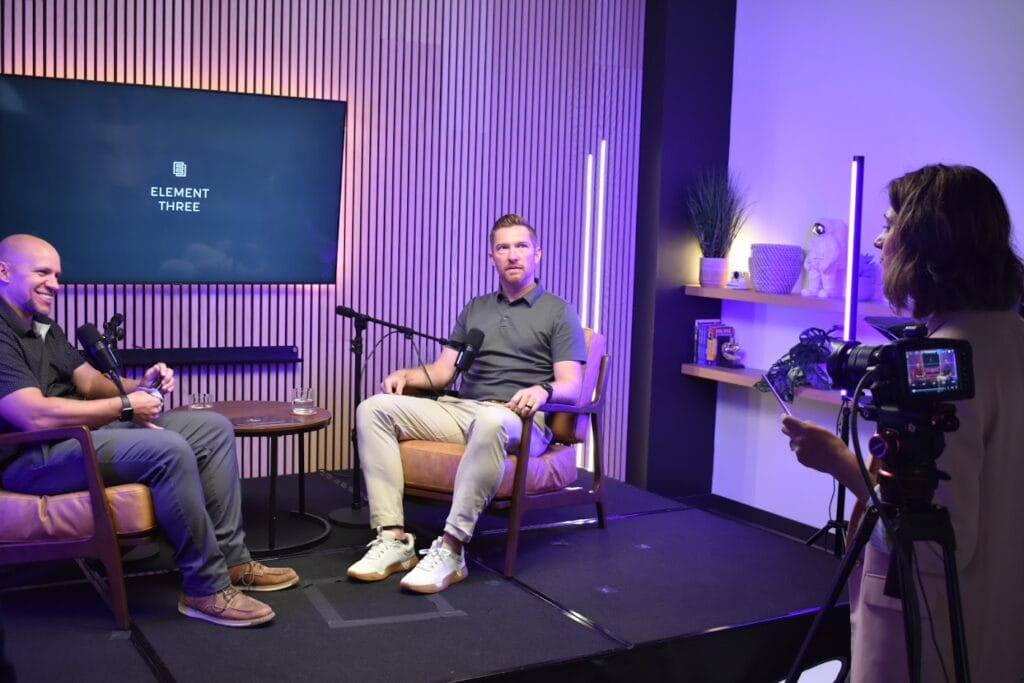
Tiffany Sauder, founder of Element Three and host of The Life of And, which has reached 320+ episodes and a top 5% global ranking, described this dynamic clearly. Podcasting, she said, gives founders and executives a way to “scale relationships.” When someone hears your inflection points and lived experience through audio, it creates a kind of connection that other content formats can’t match. For her, the relational dimension of the show wasn’t a side effect. It was the point.
Guest-to-Opportunity Rate is the metric I’d encourage every B2B podcast team to start tracking. It’s simple: of the guests who have appeared on your show in the last 12 months, how many have become customers, partners, referral sources, or meaningful business relationships?
You don’t need to over-engineer this. A spreadsheet with guest names, company, role, relationship status at time of interview, and outcome at 90/180/365 days will tell you more about podcast ROI than any analytics dashboard.
Here’s what you’ll typically find when you start tracking it: the conversion isn’t always the guest themselves. Sometimes a guest’s colleague hears the episode and reaches out. Sometimes a guest refers a client six months later because your show stayed in their mind. Sometimes the guest joins your advisory board. The relationship infrastructure a podcast creates is more durable and far-reaching than most marketing leaders realize, but only if you’re measuring it.
You can see this dynamic at work across the client shows we support. The value is rarely just the episode. It’s the relationship that starts with the recording and extends well beyond the publish date.
Brand ROI: What to Measure When the Value Is Harder to Quantify
Brand ROI is the category where most marketing leaders either over-index or give up entirely. Neither response serves you well.
Over-indexing means treating every vague brand signal as proof the podcast is working. Giving up means waiting for perfect attribution that will never arrive. The right posture is to build a consistent set of directional metrics and watch them over time.
Brand ROI from a podcast shows up in several forms:
Category positioning. Is your show being associated with specific topics you want to own? Are competitors starting to sound like you? Are industry analysts, journalists, or peers referencing your show’s perspective in their own work?
Executive visibility. Podcasting builds personal authority for the host in a way that bylined articles rarely match. Speaking invitations, conference panels, and board conversations often trace back, at least in part, to the credibility built through a long-running show.
Trust signal accumulation. Brand ROI is not a single moment. It’s the cumulative effect of hundreds of episodes, each one adding to the listener’s sense that this company knows what it’s talking about. It’s impossible to attribute to any single episode, but it’s also impossible to replicate through any other channel.
Practical metrics worth tracking on a quarterly basis: LinkedIn engagement quality on show-adjacent content (not just likes, but comments from relevant people in your ICP), branded search growth, newsletter subscription growth attributed to the podcast, speaking invitations your host receives, and inbound mentions from prospects or partners who name the show unprompted.
The best feedback loop is your sales team. Ask them quarterly: “Are prospects mentioning our podcast? Are they showing up to conversations differently than they used to?” Sales teams notice when brand authority is building, even if they don’t have language for it.
One thing worth saying plainly: the absence of perfect attribution does not mean the impact isn’t real. If your podcast is building category authority, compressing sales cycles, and creating relationship infrastructure with the right people, that is extraordinary ROI. The mistake is demanding that it show up in a spreadsheet the same way an ad campaign does.
A Leadership Reporting Framework
Here’s a practical structure you can use to report podcast performance in executive conversations. It tracks all three ROI categories and creates a consistent baseline for quarterly review.
Pipeline Metrics — Monthly
- Self-reported attribution (prospects or customers who named the show as part of their journey)
- Sales call mentions (raw count, sourced from monthly sales team ask)
- Active pipeline with at least one episode engagement touch
- Influenced opportunities closed in period
Pipeline Metrics — Quarterly
- Average time-to-close for podcast-influenced opportunities vs. baseline
- Customer expansion conversations where podcast content was referenced
Relationship Metrics — Monthly
- Guest pipeline: number of guests recorded, their role and company, relationship status
- New connections initiated by guests post-episode (LinkedIn connections, direct outreach, referrals)
Relationship Metrics — Quarterly
- Guest-to-Opportunity Rate (trailing 12 months, updated quarterly)
- Partnership or referral conversations that originated from a guest relationship
- Notable inbound from guest’s audience or network
Brand Metrics — Monthly
- LinkedIn engagement quality on podcast-adjacent posts (flag comments from ICP-relevant accounts)
- Episode completions and average retention rate
- Newsletter subscribers attributed to podcast
Brand Metrics — Quarterly
- Branded search trend (directional, not precise)
- Speaking invitations or media requests citing the show
- Sales team brand perception input (qualitative, structured as a brief survey)
- New guest quality score (are the guests getting better? Are they more strategically relevant?)
This doesn’t require expensive tooling. It requires intentional tracking and a team commitment to asking the right questions in the right places.
If you want a structured approach to building or improving this system, a podcast strategy audit is a useful starting point. It maps your current show against your business goals and surfaces where measurement gaps are costing you visibility into performance.
Conclusion
The companies getting the best results from podcasting are not the ones obsessing over download counts. They’re the ones who decided early, often before they launched, that the show needed to serve specific business goals, and then built the measurement infrastructure to track whether it was.
Gayle Kalvert, founder of a B2B marketing agency and host of two shows produced by Share Your Genius, described the shift in thinking this way: she didn’t come to podcasting with a clear picture of ROI. She came with an instinct that the medium was worth taking seriously. What changed was having a team that asked the right questions from the first meeting: “What are you actually trying to achieve? What’s your ultimate desired outcome?” And then built toward those answers.
That’s the work. Not optimizing downloads. Optimizing outcomes.
Downloads tell you who showed up. Business metrics tell you what happened next. The most durable podcast programs in B2B are built by teams who know the difference and measure accordingly.
The goal of a B2B podcast isn’t to build the largest audience possible. It’s to create the greatest business impact possible.
If you’re ready to build a podcast measurement system that leadership actually cares about, let’s talk about your show.