“People buy from people they trust. They trust people they know.”
There’s a version of your marketing strategy in which your most credible, most trusted, most conversion-ready content never gets created. Not because your team lacks talent. Not because you lack budget. But because the people inside your company who actually know what they’re talking about are sitting on the sidelines while your brand channel keeps posting into the void.
That has to stop.
We are living through a fundamental shift in how trust is built before a purchase. The old playbook assumed that a clean website, a polished product page, and a steady drip of brand content would get you there. It won’t. Not anymore. What’s actually moving buyers today is something much harder to manufacture: a real person they recognize, whose voice they know, whose ideas they’ve been consuming for months before your SDR ever reaches out.
That person can come from inside your company. In fact, they probably already work there. You just haven’t given them the runway to become who they could be for your brand.
This is the internal influencer advantage. And it may be the most underutilized growth lever in B2B right now.
Why Corporate Content Has Stopped Working
Before we talk about the solution, it’s worth understanding why the problem is so acute.
Brand content is losing. Not losing in the dramatic, catastrophic way that makes for a good post-mortem, but losing slowly and quietly, the way trust erodes when every interaction feels engineered. Audiences have gotten good at detecting when something was made to fit the brand rather than for them. They can feel when a post came from a committee. They know when a LinkedIn update was written by someone who didn’t actually experience the thing they’re writing about.
“Brands were trained to believe that control equals credibility. But I think the brands that are going to win are the ones that understand that authenticity really is the name of the game. It’s not perfection.”
— Melissa Grabiner, HR Thought Leader & Brand Creator
The data is catching up to the instinct. Algorithms now reward engagement over aesthetics. Individual LinkedIn profiles reach eight to twelve times the audience of brand pages. Buyers build shortlists long before they respond to outreach. The Forrester 2026 Buyer Insights report found that B2B buyers consult six external channels before deciding to engage with a vendor, six channels before a phone call, a form fill, or a cold email.
The broader pattern is hard to ignore. Content from individual employees consistently outperforms brand pages in both reach and engagement, not just because it shows up more often, but because people actively choose to engage with it. By the time sales enters the picture, much of the decision has already been shaped by the ideas, perspectives, and voices buyers have been exposed to long before the first outreach ever lands.
This is the shift most companies have not fully absorbed. Marketing is no longer a funnel you push people through. It is a distributed system of influence across channels, built on trust that compounds over time. In that system, the most credible version of your brand is not your logo. It is your people.
What an Internal Influencer Actually Is
Let’s define this clearly, because the term can slip into something vague if you’re not careful.
An internal influencer is not a brand ambassador who gets handed a script and told to post it. It’s not an employee who cross-shares the company’s content on their personal feed. And it’s definitely not an AI avatar making videos on behalf of your executives, something Brendan Hufford described as content that “fundamentally insults your audience into thinking you didn’t care enough to take the time.”
An internal influencer is a subject-matter expert within your company who creates content rooted in their genuine expertise, speaks in their own voice, builds an audience around a specific topic or point of view, and, in doing so, builds trust for your brand before buyers are ready to buy.
The keyword is genuine. Heike Young, who grew organic LinkedIn impressions for a product line from 75,000 to 1.3 million at a single event using nothing but a phone and authentic subject matter expertise, put it plainly:
“Everybody wants their employees to post on LinkedIn. Everybody knows this is a great low-cost way to build a brand. What a lot of companies are doing is having people copy and paste links and boilerplate copy into LinkedIn. That’s not going to work.”
— Heike Young, B2B Marketing & EGC Strategist
What works is deploying people who have real knowledge to share, trusting them to share it in their own way, and giving them the structure and support to do it consistently.
Why This Shortens Sales Cycles
If you need to make a business case for this, start here.
Leslie Venetz, one of the most-followed voices in B2B sales, breaks down buyer psychology in a way that should reframe how you think about the whole enterprise.
“When we give people an opportunity to get to know us, know our company, know our product in a way that feels a little bit more personal, they’re starting to build that parasocial relationship. They’re starting to imagine themselves as the user of the product, which means when they finally decide to buy, there is a lot less selling required.”
— Leslie Venetz, B2B Sales Strategist & Founder
That phrase, “less selling required,” is worth sitting with. When a prospect already knows your CMO’s perspective on the problem your product solves, when they’ve been following your PM’s takes on industry trends for six months, when they saw your VP of Sales break down a customer story three weeks ago, something fundamental changes in how the deal begins.
Buyers are no longer entering conversations cold. They are entering with a formed point of view, shaped by repeated exposure to people inside your company. The result is not just a warmer lead. It is a compressed decision environment where risk is lower, internal champions emerge earlier, and the first meeting becomes validation rather than discovery.
Venetz also points to 58% of B2B deals being lost to no decision, and identifies one of the primary drivers: the fear of making the wrong call. A buyer who already feels like they know and trust the people behind a product has far less of that fear. The trust was built in the feed, over time, before the deal ever started. That is the difference between creating demand and capturing it.
That is compounding trust. Rachel Elsts Downey calls it “the eighth wonder of the world for a marketer.” And the compounding effect is the part that sales leaders consistently underestimate. One piece of content gets thirty views and feels like a waste of time. But 30 pieces of content from three or four people in your company over a year create an ecosystem of familiarity that no paid campaign can replicate on its own.
The Anatomy of a Winning Expert Persona
Not everyone inside your company is ready to be an internal influencer on day one, and not everyone needs to be. The goal is not to turn your entire workforce into content creators. The goal is to identify the right people, equip them with the right structure, and get out of their way.
The Niche-First Principle
Brendan Hufford has spent years thinking about what makes content actually convert, and his framework is consistent: niche credibility beats mass awareness every time in a business context.
“If we are doing business content, there has to be a level of trust where somebody looks at the person and says, ‘okay, you understand me. I feel seen in this.’ I want those moments where it’s ‘this is so us’ and they share it with their team, they bring it up in their one-on-one, they put it in a board deck.”
— Brendan Hufford, Content Strategist & Founder
When identifying who should create content and what they should create it about, start with specificity. Not “our VP of Marketing will post about B2B growth.” But “our VP of Marketing will post about what breaks down in the handoff between marketing and sales at Series B companies.”
The narrower the premise, the stronger the trust it builds with exactly the right audience.
The Right Person for the Job
The best internal influencer for your company is not necessarily your CMO or your CEO. It might be your head of customer success who talks to clients every day. It might be your product manager who has the most informed perspective on where the category is going. It might be your head of revenue enablement, or your founder, or someone three levels deep in your org who just happens to have a distinctive point of view and the courage to share it.
What you are looking for in an internal influencer is someone with a genuine point of view shaped by experience, not constructed from talking points. Someone who already talks about their area of expertise with energy and specificity in meetings. Someone who understands, even intuitively, that helping their audience beats lecturing at them. And someone who is comfortable enough with the vulnerability of sharing their thinking before it is fully polished.
The Content They Should Create
Nobody wants to be sold to before they feel known. The common mistake most internal influencers make is skipping straight to conversion. The more effective approach is sequential.
First, buyers recognize you. Then, they trust your perspective. Only then are they ready to decide. When you follow that progression intentionally, sales is no longer the starting point of the conversation. It becomes the natural outcome of it.
Leslie Venetz breaks this into a useful taxonomy: acceleration content, which is relatable and easy to engage with; authority content, which demonstrates expertise and builds credibility; and conversion content, which moves people toward a decision.
This does not mean getting personal in a way that feels forced. The McDonald’s CEO video that went viral for all the wrong reasons is the canonical example of what Venetz calls “inauthentic authenticity,” or the attempt to manufacture relatability without actually being relatable. Real personality is not a content strategy. It’s just who you are when you’re not trying to be a brand.
The Systems: How to Scale This Without Chaos
Here is where most companies get stuck. They see the logic, they identify a few people who could be internal influencers, and then the whole thing falls apart because there’s no system to support it. The creator burns out. The content gets inconsistent. Brand starts asking for approval on every post. And eventually, everyone goes back to the copy-paste campaign emails.
The Brand’s Job: Enable, Not Control
The single biggest mistake brand teams make is treating internal influencer programs like an extension of their content calendar. They hand over approved language, review everything before it posts, and wonder why the content feels flat.
“Consistency does not mean everyone should sound the same. It should mean that everyone is aligned with the core values of the company. But when individuals are given the creative freedom to write a post in their own voice, that’s when I see engagement start to rise.”
— Melissa Grabiner, HR Thought Leader & Brand Creator
The role of the brand team is not to write the content or approve every word. It is to create the conditions that make good content possible. A clear point of view. A defined audience. A shared understanding of what the company wants to be known for.
From there, translate that into a simple advocacy program. Define what each creator is known for, who they are speaking to, and what success looks like. Set focused topic boundaries, align on goals and KPIs, and give them the freedom to show up consistently in their own voice.
Protecting Spontaneity Within Structure
One of the underappreciated tensions in internal influencer programs is the push-pull between consistency and spontaneity. Resolve this wrong, and you end up with fifteen LinkedIn posts that all sound like they came from the same AI prompt.
The practical implication is simple. Give your internal influencers a small set of principles, not a long list of rules. Tell them the emotional response you want their audience to feel after engaging with their content, not the exact words you want them to use. This shift, from telling people what to say to clarifying what their audience should feel, changes everything about what gets created.
The Fear Holding Companies Back (And Why It’s Wrong)
There are two objections that reliably arise when companies consider investing in internal influencers. Both are worth taking seriously. Both are, ultimately, wrong.
“What if they leave and take their audience?”
Brendan Hufford is blunt about this: “We have no problem advertising, but we don’t own those ads. They run, we pay for them, and then it’s over. But for some reason, we feel like if we start an employee-led podcast and they leave, it’s a catastrophe.”
The internal influencer program that worked well creates more value than the individual who departs. And if you treated them well, they will be evangelists for your company long after they leave. The only scenario where departure is genuinely costly is the one where you put all your eggs in a single person’s basket, which is a system design problem, not an internal influencer problem.
“What if they become too popular and want to quit?”
Amanda Natividad, who grew from a thousand to a hundred thousand followers without paid media, addresses this directly: “It’s nearly impossible. The top 1% of influencers can quit their day jobs. It’s really hard to do in a way that makes meaningful income. Realistically speaking, it’s probably not going to happen very quickly, and it’s not going to happen by happenstance.”
The practical risk is not that your head of product becomes a LinkedIn celebrity and walks out the door. The practical risk is that you don’t give them the platform and they slowly lose interest. The risk is inaction, not action.
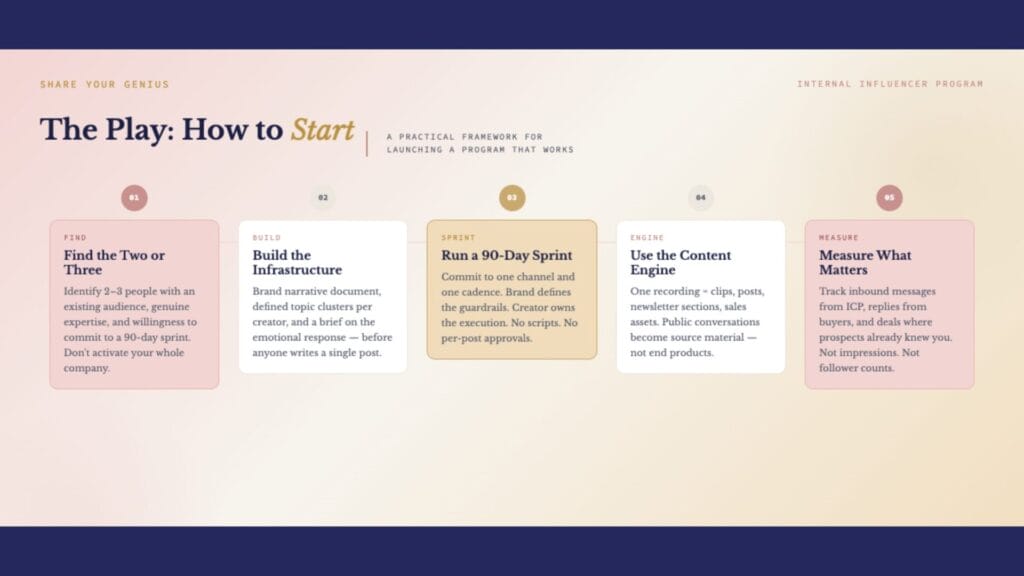
The Play: How to Start
Here is a practical framework for launching an internal influencer program that actually works.
Step 1: Find the Two or Three
Do not try to activate your entire company. Identify two to three people who already have some audience or track record of sharing ideas publicly, who have a genuine area of expertise relevant to your buyers, and who are willing to commit to a 90-day sprint. These are your pilot creators.
Rachel Elsts Downey’s advice: identify employees who have “indicated interest or are already engaged online” and build a pilot program around them, with coaching, content direction, and clear messaging targets.
Step 2: Build the Infrastructure
Before anyone creates a single piece of content, three things need to be in place. First, a brand narrative document that clearly defines your core point of view, the audience you serve, and what truly sets you apart from competitors.
Second, a defined topic cluster for each creator, not broad “marketing topics,” but three to five focused areas where their voice can genuinely own the conversation.
And third, a clear brief on the emotional response you want their content to evoke, rather than prescribing the exact words they should use.
Step 3: Run a 90-Day Sprint
Commit to a channel. Commit to a cadence. Create content in your own voice within your defined topic cluster and track engagement, not just impressions, as your primary signal.
The most important rule of the sprint: no scripts, no mandatory approvals for individual posts. The brand defines the guardrails. The creator owns the execution.
Step 4: Use the Content Engine
When your creators are having conversations, building ideas, and testing perspectives in public, you accumulate source material that becomes long-form content, newsletter fodder, sales enablement assets, and social posts. One good conversation, one recorded podcast episode, one LinkedIn Live — these are not end products. They are source material. From a single episode, you can pull clips, write posts, build a newsletter section, develop a talk track, and create half a dozen content assets that extend your reach into every corner of your buyers’ feeds.
Step 5: Measure What Actually Matters
The metrics that matter in the first 90 days are not impressions or follower counts. They are qualitative signals: inbound messages from people in your ICP, replies from potential buyers, conversations started at events because someone recognized your creator’s name, and deals where a prospect already knew who the company was before the first outreach. Those are harder to attribute. They are also the ones that actually matter.
The Framework, Distilled
For those who want something concrete to bring back to their team, here is the internal influencer model in its simplest form.
The Creator Brief
The brief should start with clarity. Who are you speaking to? What specific person are you addressing? What problem do you understand better than most? What belief do you hold that runs against the consensus? And what emotional response should your content create?
The Content Operating System
The system should run on three types of content in rotation: acceleration content that expands reach, authority content that builds credibility, and connection content that builds familiarity and emotional resonance over time.
Never more than one in five posts should be conversion-focused.
The Brand Operating Agreement
Messaging should be built on pillars, not scripts. It starts with a clear set of topics to own, not prescribed language to repeat.
From there, there needs to be a shared understanding of the emotional response each initiative is meant to create, supported by a feedback system grounded in dialogue rather than approval queues.
The 90-Day Sprint Model
Commit to a channel and define a cadence that is sustainable over time. From there, create in your own voice within the topic cluster while tracking signals, not just metrics.
At the 90-day mark, review what is working, then decide what to double down on.
People buy from people they trust. They trust people they know. The most scalable thing you can build right now is a set of internal subject matter experts who show up consistently, speak with genuine expertise, and let the people who are going to buy from you get to know them before the deal ever starts.
The companies that figure this out in the next 18 months will have a trust advantage that paid media cannot buy, and competitor content cannot replicate.
Your people are your best marketing channel. It’s time to act like it.