Let me ask you something. When’s the last time you listened to a B2B podcast and thought, ‘damn, that was actually good’?
Not ‘fine.’ Not ‘I guess I got something out of it.’ Actually good. The kind where you’re in the middle of a run or stuck in traffic, and you rewind because you want to catch that part again.
If you’re drawing a blank, you’re not alone. And you’re probably making at least a few of the same mistakes that are quietly tanking the show you spent real time and real money building.
Our CEO, Rachel Elsts Downey, founder of Share Your Genius, is one of the most clear-eyed thinkers in the B2B podcast space. We asked for her thoughts on the B2B podcast space. No corporate fluff. No, ‘well, it depends.’ Just the stuff brands screw up, why they screw it up, and what they should actually be doing instead.
Here’s what she said.
The first thing Rachel would kill on 80% of B2B podcasts
No dramatic buildup. Her answer was immediate: the show intro.
That pre-produced jingle. The little ‘welcome to [Brand Name] Podcast where we talk about [vague industry thing].’ The one that sounds like it was made to fill space and mostly just burns airtime.
“It adds no value, and it actually takes up airtime. If you look at some of the biggest shows on YouTube or in podcasting, they don’t have a little jingle. They just cut to the chase, and you know where you’re at.”
Most brands would never waste the first sixty seconds of a sales call playing a little theme song. But somehow, in podcasting, it became the norm.
The deeper issue Rachel is pointing at isn’t just the jingle. It’s a pattern: the disconnect between what people actually enjoy consuming and what they create when they’re in ‘brand mode.’ She puts it plainly: people are better at criticizing than at creating. They know what they like, but they struggle to articulate why, so when they go to build something, what comes out is often something they’d skip right past in their own feed.
Downloads is the most overrated metric in B2B podcasts
Downloads. It’s always downloads.
Leadership wants to see the number go up. Marketing wants to show leadership that the number is going up. And somewhere in that pressure loop, the actual purpose of the podcast gets completely lost.
Rachel draws a clear line between two types of metrics that most teams collapse into a single category: performance metrics and success metrics.
Performance metrics — downloads, consumption rate, return listens — tell you how the show is doing editorially. They’re signals. If your downloads are growing but consumption is low, your reach is outpacing your content quality. If consumption is high but downloads are flat, you have a distribution problem, not a content problem. Both are useful. Neither is the whole story.
Success metrics are different. They’re tied to what you actually said you’d podcast for in the first place. Pipeline influenced. Relationships built with strategic accounts. Internal alignment around a consistent message. Content your sales team actually uses. These are the metrics that justify the investment, and they need to be defined before the first episode ever drops.
“Don’t go into a boardroom celebrating a thousand downloads when they care whether or not it influenced the pipeline.”
This is where many shows end up on the chopping block unfairly. Not because the podcast failed, but because nobody defined what success looked like before they started, and now it’s being measured against the wrong standard.
What’s actually more dangerous than low downloads
No strategy is more dangerous. By a lot.
Low downloads with a clear strategy means you have something to adjust. You know your premise, your audience, and your distribution plan. You tweak. You test. You improve. It’s a performance problem, and performance problems are solvable.
No strategy with any number of downloads means you have no idea if you’re winning or why. You can’t improve what you can’t define. And if downloads ever dip — which they will — there’s nothing to fall back on. No case to make to leadership. No direction to turn.
The strategy has to come first. Not as an afterthought, you develop once things aren’t working. Before the mic goes on. Before the guest gets booked. Before anyone decides what ‘good’ looks like.
The ABM podcast play that almost always backfires
Here’s a move that’s become extremely common: build a target list of accounts you want to close, invite decision-makers on as guests, call it ABM, and pat yourself on the back.
Using a B2B podcast to build meaningful relationships is genuinely powerful. The problem is when the podcast is designed entirely around that one motion, and then the content from those conversations gets jammed into a broader content repurposing strategy that was never built to support it.
These are two completely different goals. The conversation you’d have with a warm prospect is not the same as the content your audience needs. And when you try to make one piece of content serve both, you usually end up with something that does neither well.
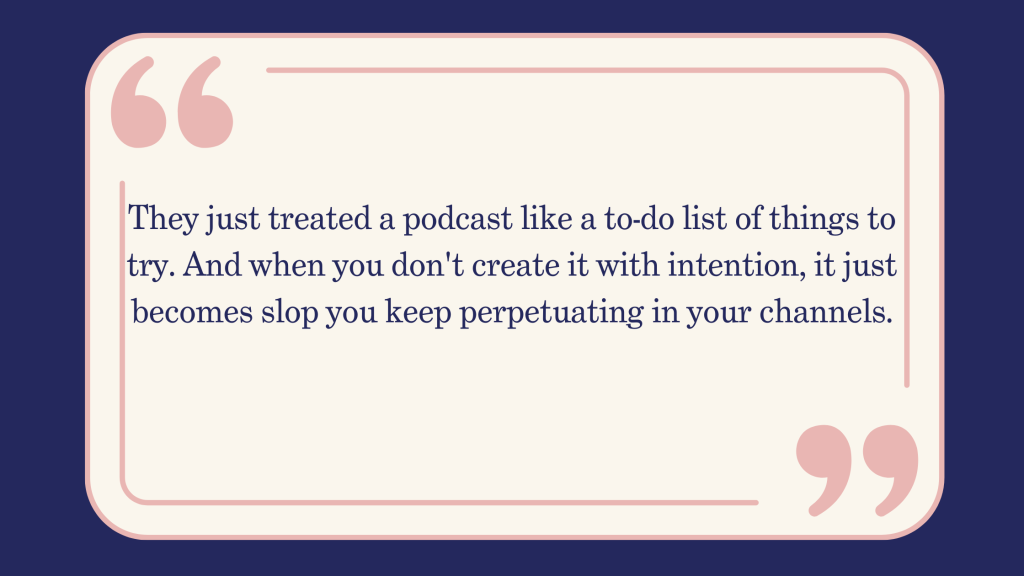
There’s also the content repurposing myth worth addressing here. The promise is seductive: record one show, slice it into twelve pieces of content, flood every channel. In theory, it’s efficient. In practice, if the show wasn’t designed with that output in mind from the start, if the conversations aren’t structured, the questions aren’t built for clips, the premise doesn’t generate the kind of insights your audience actually cares about, what you end up repurposing is just noise at scale.
Why most podcasts die between episodes five and ten
The industry calls it pod fade. What it actually is: launching a show when you really only had an episode.
The ideas were there for the first few conversations. The excitement was there for the launch. But there was never a real production plan — no story arc, no guest pipeline, no workflow to make it sustainable beyond the initial burst of energy.
Her solution for brands that aren’t quite ready to go all-in: don’t launch a show. Launch a series. A series has a defined run, a clear beginning and end, and it doesn’t look like you abandoned something if it wraps up. It gives you the data and the experience to know whether a full show makes sense, without painting yourself into a corner.
She also flags something important about the launch itself: most brands don’t set appropriate expectations based on the effort they’re actually willing to put in. Field of Dreams is not a podcasting strategy. You can build something great and have nobody hear it. If you don’t have a plan to tell people it exists, get your internal team activated, and put some budget behind the story you’re trying to tell.
The fastest way to waste six figures on a podcast
Rachel has a story for this one.
A client built a show, got the content, and used it to fund the production of a documentary. A serious creative investment. Midway through production, leadership shifted the company’s positioning — who they were, what they stood for, who they were for. The documentary became obsolete before it was finished. All that work. Never saw the light of day.
The reason isn’t that they spent too much. The reason is that they started creating before they got clear on the fundamentals: go-to-market messaging, content pillars, audience, and who should actually be speaking. When those things are fuzzy, everything built on top of them is fragile.
There’s a second, quieter way to waste the investment: create good content and then tell nobody about it. Brands record thoughtful conversations with guests who have real things to say, then never even send them a link when the episode goes live.
“Not only did you blow the investment you put into creating that content, but you also lost the opportunity to deepen the relationship with somebody.”
Build a Go Live Kit for every episode. A link to a curated clip where the guest looks and sounds great, with a note explaining why you picked it. And an actual ask, ‘I’m sharing this on Tuesday, can you engage with the post? Here’s the link. Simple, specific, and it closes the loop on the relationship the show was supposed to be building in the first place.
Not every founder should host a B2B podcast. Every brand should have a show.
There’s a version of founder-led content conversation that Rachel finds a bit pointless. The question of ‘should founders be creating content at all’ is, as she puts it, ‘inherently a dumb question.’ People buy from people. Founders are the best storytellers for the companies they built. Full stop.
But that doesn’t mean every founder should host a podcast. That’s a different question, and the answer is more nuanced.
She tells a story about a client whose founder was brilliant — genuinely, unusually brilliant — but whose brain just didn’t work in a way that made for engaging conversation. The ‘founder as host, asking thoughtful follow-up questions in real-time’ format was never going to work for him.
So they flipped it. The content manager became the host. The founder became the expert guest. He shared his thinking in the format that actually worked for how his mind operates, without the performance pressure of hosting. The content manager shaped the conversation to reflect what the audience actually needed. Everyone won.
The principle she keeps returning to is ‘people-first media.’ Don’t start with the format. Start with the people you have. What are they actually good at? What format lets them show up in a way that’s authentic and valuable? Build the show around that.
On content courage — and why ‘I don’t have time’ usually means something else
When an executive says they don’t have time to create content, Rachel hears something different.
Creating content is courageous. You’re on camera. You’re saying things on record. Someone is producing it, cutting it, putting it in front of people. There’s a real vulnerability in that, even if it’s not always consciously felt.
‘I don’t have time’ is often the socially acceptable cover story for ‘I’m not sure I want to be seen like that.’ And that’s worth taking seriously rather than dismissing. The right response isn’t to push harder on the calendar. It’s to create an environment where the person actually feels safe to show up.
Her practical challenge to any executive running that excuse: What has to be true for this to be possible? Is it 45 minutes a quarter? An hour a month? A format where you’re the expert being interviewed instead of the one doing the interviewing? There’s almost always a version that works. The obstacle isn’t the calendar.
Two things Rachel would never do on a branded show, even if they ‘worked’
First: bait and switch guests. Never invite someone on, spend an hour with them, and then drop a pitch at the end without their knowledge. It’s a violation of their time and their trust. And it poisons the exact relationship the show was supposed to be building.
Second: ask guests to introduce themselves. This one she’s passionate about.
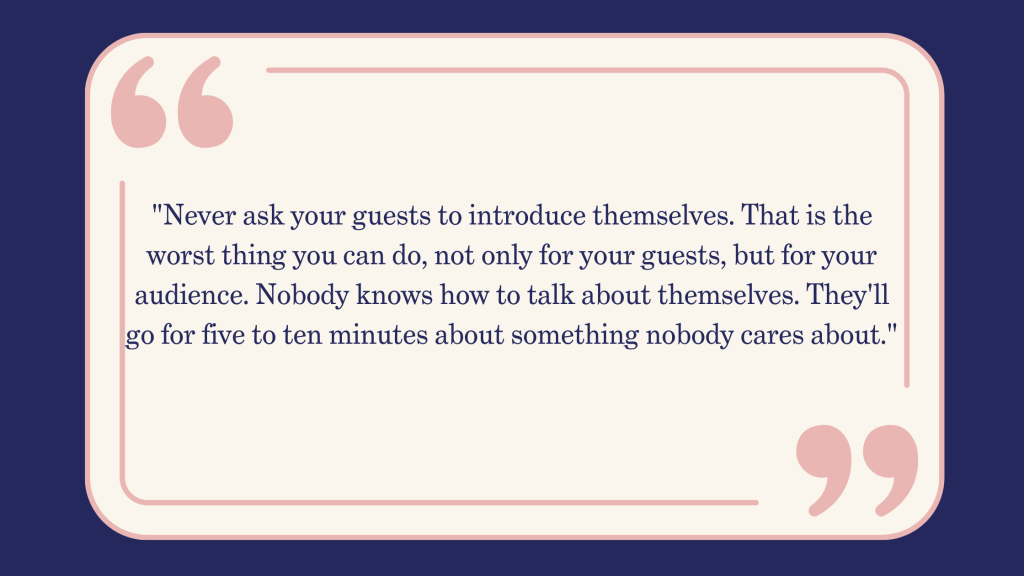
Think about any talk show. They never open with ‘tell the audience about yourself.’ Instead, the host sets the context: ‘I asked Brendan on because I respect how he thinks about this specific thing, and my audience is curious about exactly this.’ That’s 10 seconds. It gives the audience everything they need to care. And it respects both the guest’s expertise and the listener’s time.
On chasing downloads and feeding a beast you never meant to feed
There’s a pattern Rachel sees across the media landscape — B2C and B2B alike — where the pressure to keep numbers growing starts to warp what gets made.
More downloads mean more reach, which means more guests, which means more sensational content. And slowly, the show that started with a clear purpose becomes something that serves the algorithm instead of the audience.
For brands, the version of this is: chasing downloads makes you forget why you started the podcast in the first place. You end up optimizing for a metric that doesn’t reflect whether the show is actually delivering value to the business.
Her prescription: define your ‘why’ before you define your ‘how.’ Make sure everyone who has a stake in this — the marketing team, the executives, the sales team — is aligned on what the show is supposed to accomplish. And then build the metrics around that, not the other way around.
And when you hit a rough patch — lower downloads, a season that didn’t land as well — you have something to fall back on. A reason to stay in it. A direction to adjust toward.
Is podcasting harder now than five years ago?
Yes. And no.
It’s harder because there’s more noise and more advice, and much of it is generic. She sat on a sales call recently with a prospect who’d bought a course from someone with a big, popular podcast. That person’s advice was technically correct but completely wrong for what this particular brand was trying to do. The more content there is about podcasting, the harder it is to know what applies to you.
It’s easier because the tools are better. Production quality that used to require a full studio can now be done from a home office. Distribution is more accessible. The barrier to getting something out there has never been lower.
But the thing that’s just as hard now as it was five years ago — maybe harder — is the part that matters most: taking the time to design something worth creating. Getting the premise right. Thinking through the distribution before you start. Knowing who it’s for and what it needs to do.
“Slow down enough so that you can speed up in creating something worthwhile.”
Most B2B podcasts don’t fail because the host isn’t charismatic enough, or the audio quality is off, or the guests aren’t impressive. They fail because nobody slowed down long enough to ask why they were making it in the first place.
A B2B podcast isn’t a box to check. It isn’t a repurposing engine. It isn’t an ABM play dressed up in a mic and headphones.
Done right, it’s one of the most powerful ways a brand can build trust, capture expert thinking, deepen real relationships, and create content that actually moves people — all from a single investment in showing up and having an honest conversation.
The hard part isn’t the production. It’s the intention.
Get that right, and everything else is a lot easier to figure out.
Rachel Downey is the founder of Share Your Genius, a content agency that helps B2B brands build content engines.