The sound quality didn’t kill your podcast. Nor did the editing. Your strategy did.
Here’s how it usually goes.
A company decides to launch a podcast. There’s an all-hands meeting. Everyone posts the trailer on LinkedIn the day it drops, and for a minute, the numbers look great. Hundreds of downloads. Hundreds of listens.
Of course they do: everyone in the building just clicked play.
Then episode two comes out. And episode three. And the numbers that felt like proof of concept during launch week quietly become the numbers nobody wants to bring up in the marketing meeting.
If that sounds familiar, the instinct is usually to blame something tactical. Better mics. A tighter edit. A new intro. But that’s rarely what’s actually broken. Most B2B podcasts that stall aren’t suffering from a production problem. They have a purpose problem, and no amount of gear fixes that.
Most B2B Podcasts Are Built Backward
Ask a marketing team why their show underperformed, and you’ll usually hear about scheduling, editing turnaround, or a guest who canceled twice.
You’ll rarely hear anyone answer the questions that actually determine whether a B2B podcast works: Who is this for? Why should they care? What relationship are we actually trying to build?
That’s the uncomfortable truth about why B2B podcasts fail: most branded podcasts are built backward. Companies pick a recording cadence, book the studio, buy the equipment, and start publishing before anyone has answered what business outcome the show is supposed to influence or why it needs to exist in the first place.
Building a podcast and building a podcast strategy are two different projects, and most teams only ever do the first one.
The pattern shows up early. All the momentum goes into the launch. Everyone internally shares the trailer, the numbers look strong because the whole company is listening, and then that’s the last time anyone treats the show like an event.
People assume success will happen quickly, and when it doesn’t, the show gets quietly deprioritized instead of receiving the strategic attention it needed from day one.
Mistake #1: Treating your B2B Podcast as Content Instead of a Relationship Engine
The most common mistake in B2B podcast strategy is measuring the wrong thing. Teams track episodes published. They should be tracking relationships created.
Companies treat the show as a pipeline endgame or, just as often, as a content-generation machine, instead of using it as a relationship engine, and that’s a real distinction, not a semantic one.
The strongest B2B shows do bring on guests who may eventually become clients, but that’s not the selection criteria. The criteria is who you actually want a relationship with: clients, prospects, partners, or connectors in your network who can bring new people into the audience.
That shift changes everything downstream. A show built purely to close deals invites guests based on whose logo might convert. A show built as a relationship engine invites guests based on who’s worth knowing, and lets the business value follow from there.
If you want to know whether your show is actually working, stop asking how many episodes shipped this quarter and start asking what relationships it created. That’s a much harder number to fake.
Mistake #2: Trying to Build a Show for Everyone
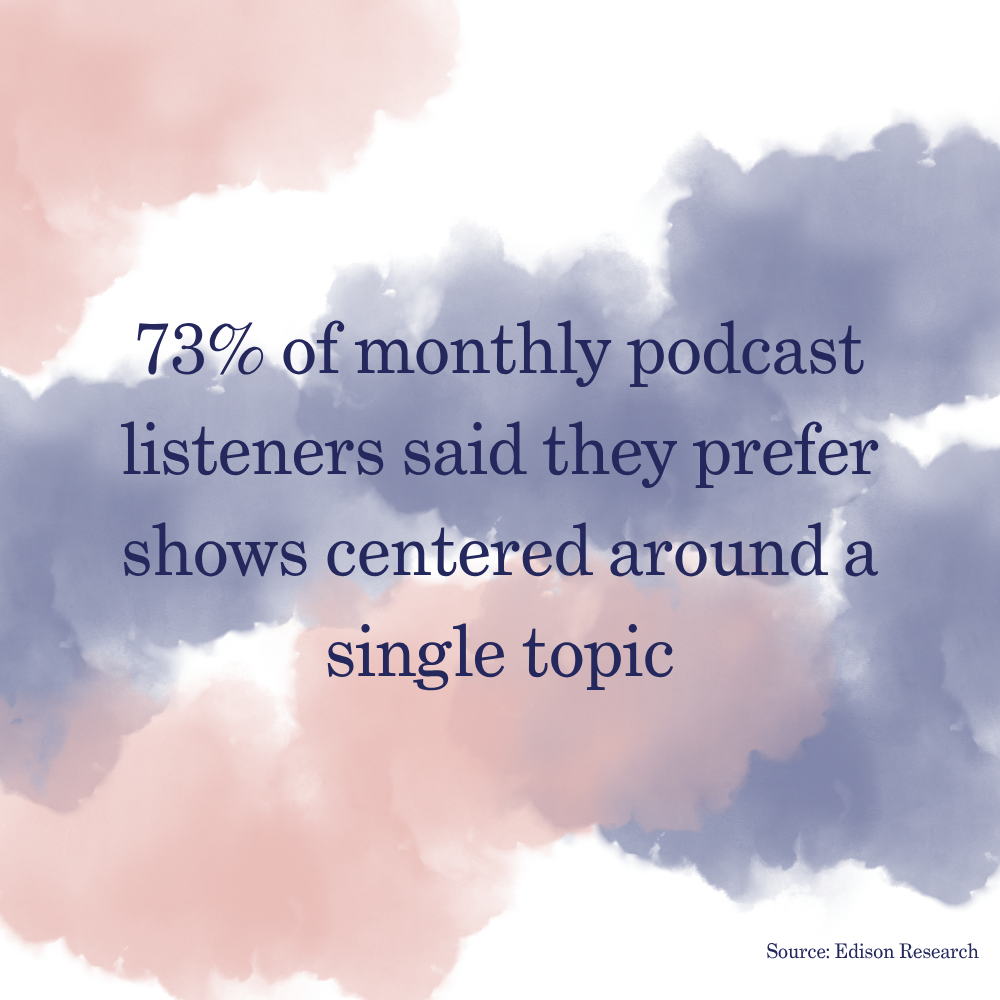
Nearly every kickoff call includes some version of “we want to reach anyone interested in our industry.” It’s an understandable instinct. It’s also close to a guarantee that the show will land with no one in particular. Edison Research’s Infinite Dial 2025 found that 73% of monthly podcast listeners prefer shows centered on a single topic or passion point.
Building for a very general audience instead of a specific buyer is one of the clearest branded podcast strategy mistakes there is, because vague audiences produce vague episodes. The shows that actually work are niched down to a specific ICP on purpose.
A show that reaches a thousand people in your target market, who have real interest in what you’re building and might genuinely buy from you, will outperform a show reaching a hundred thousand people who have no reason to care.
That specificity isn’t a limitation. It’s the entire mechanism. Once a show knows exactly who it’s for, guest selection gets easier, question design gets sharper, and the show stops trying to be something for everybody. The best B2B shows aren’t afraid to not be for everybody. That’s precisely what makes them work for the people they’re actually for.
Mistake #3: Optimizing for Downloads Instead of Depth
Downloads are the easiest metric to include on a slide. They’re also close to the least useful number for judging whether a B2B podcast is actually working.
A show can post a great download count and still be failing at the only thing that matters to the business. We’ve made this argument before: the fix is to separate performance metrics from success metrics.
Performance metrics indicate how a show is performing editorially. Success metrics tell you whether it’s doing the job it was actually built to do, and those are rarely the same number.
The strongest B2B podcasts optimize for depth rather than chasing volume for its own sake, using the show as a thought-leadership engine that fills every stage of the funnel: brand-building conversations at the top, sales-enablement episodes with real clients describing real results, and deeply technical conversations with subject-matter experts further down. The teams getting this wrong are spray-praying their content out into the world and hoping somebody happens to be listening.
Depth is what makes an episode useful to a prospect who finds it six months from now. A download count on launch day never does that.
This lines up with what other people building B2B shows have found too: once audio and video quality clear a professional floor, more polish buys almost nothing. It’s the guest list and the questions that move the outcome, not the intro sting.
Mistake #4: Treating the Podcast as a Standalone Marketing Project
The fourth mistake is quieter than the others, and it’s often the one that kills a show a year in: nobody connected it to how the business actually grows.
Brand awareness is genuinely valuable, but a show that lives in its own lane, disconnected from sales enablement, demand gen, and the rest of the marketing calendar, becomes very easy for an organization to lose interest in.
The strongest shows are intentionally wired into sales and marketing, so account executives and SDRs can pull clips that actually match what they’re already selling. Founder-led shows run into a version of this problem too. Handing a founder a mic and hoping something interesting comes out can work if that founder already has a massive built-in audience. For most companies, that’s not the situation, and a podcast with no connection to the go-to-market motion has nowhere to plug in once the novelty of the launch wears off.
What Successful B2B Podcasts Do Differently
None of this means production quality doesn’t matter. It does. Sound and visual quality still need real attention, and plenty of teams still aren’t thinking about YouTube, short-form clips, or turning one conversation into content across formats.
But it’s an amplifier, not a foundation. It can make a strategically strong show sound and look as good as the thinking already inside it. It can’t manufacture thinking that was never there.
The B2B podcasts that actually work share traits that have nothing to do with equipment. They’re built around a specific audience instead of a vague one. They treat guests as relationships instead of transactions. They measure success by business outcomes rather than download counts. And they’re wired into how the company actually sells, not sitting off to the side as a separate content project.
None of that shows up on a gear list. None of it gets fixed with a better edit.
If your B2B podcast isn’t working, it’s rarely the format, the host’s charisma, or the equipment budget. It’s whether anyone slowed down long enough to define who the show is for and what it’s supposed to do before the first episode was ever recorded.
If it’s stalled, has lost internal momentum, or has never found its footing, the fix isn’t a better mic. It’s going back to who this is for, what relationship you’re building, and what the business needs the show to do.
Book a show strategy review, and let’s figure out what the show is actually supposed to be doing.